
Phone
Working hours
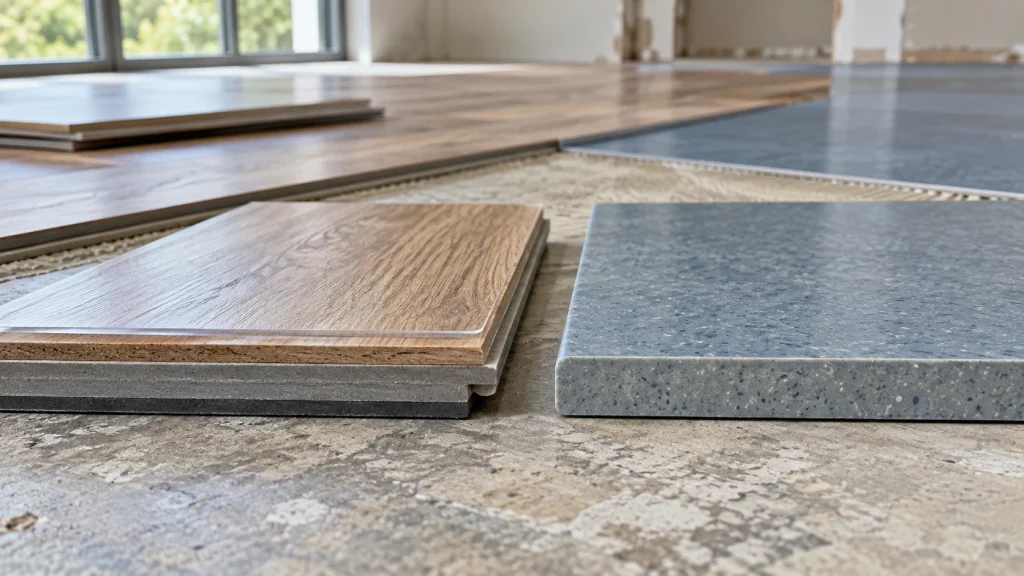
Luxury vinyl tile (LVT) and homogeneous vinyl can look similar from across a room, but their construction is different. LVT is built from layers with separate jobs; homogeneous vinyl has a consistent composition through its thickness. That distinction affects the designs available, how visible wear may become, and what installers need to consider. Understanding the layers is a useful starting point when comparing vinyl flooring for a home, office, or busy public space.
LVT is usually sold as planks or tiles. Its appearance comes from a printed design layer, which can depict wood, stone, or other patterns. A clear wear layer sits above the print and protects it during ordinary use. Beneath the design are structural layers that support the product.
This arrangement gives LVT much of its visual flexibility. Because the pattern is printed, the floor can show details such as grain, colour variation, and individual tile or plank shapes. The printed image, however, does not run through the full thickness. If damage penetrates the protective surface and reaches the design layer, the mark may stand out. The thickness and properties of the wear layer therefore matter more than the overall thickness alone when assessing a particular LVT product.
Separate planks and tiles create joints across the finished floor. Their size and pattern can help define the look of a room, but the joints also need careful installation and appropriate cleaning.
Homogeneous vinyl is made with a consistent composition through the thickness of the flooring rather than a separate printed image under a clear wear layer. Colour and pattern are part of the material itself. It is commonly supplied in sheets, although formats and surface treatments depend on the product.
That construction can make wear less visually conspicuous because there is no distinct image layer to expose. Its performance still depends on the formulation, any surface treatment, the installation, and the conditions of use. A scratch that is less obvious in one pattern may be quite noticeable in a plain, light-coloured floor.
The design approach also differs from LVT. Homogeneous vinyl is often chosen for a consistent, understated surface rather than a close imitation of timber or stone. If a project calls for a detailed natural-material look, LVT generally offers more printed design choices. If visual continuity across a large area is the priority, a sheet product may be worth considering.
Layer construction does not, by itself, identify the better floor. It points to questions that need different answers for each product.
For example, a small office might want a timber-like floor while also using chairs with casters. LVT could provide the desired appearance, but the selected range must suit that use, and the chair and cleaning arrangements should match the flooring guidance. In a large corridor where a continuous appearance matters more than a wood pattern, homogeneous sheet vinyl might be a closer fit. These are starting points for comparing products, not automatic rules for either space.
Construction is only one part of the finished floor. Vinyl tends to reveal defects in the surface beneath it, so the subfloor needs to be assessed for flatness, stability, and moisture before installation. Uneven areas can affect the appearance of both products, while an unsuitable substrate may interfere with adhesion or the finished result. Floor preparation, including levelling where needed, deserves as much attention as the visible material.
Installation details differ with the chosen format and site. With LVT, the installer must plan the plank or tile layout and deal carefully with joints and edges. Sheet flooring requires planning for sheet widths, joins, and the shape of the room. Where moisture exposure or hygiene is a concern, discuss the complete floor system, including seams and edges; the word vinyl alone does not establish that an installed floor is watertight.
It is also easy to confuse overall thickness with suitability. A thicker floor is not necessarily the right floor for a particular traffic level, substrate, or cleaning routine. Ask what each layer does in an LVT product, and review the stated characteristics of a homogeneous product as a whole. Physical samples can help you judge colour and texture, while product information is needed to assess use and care.
For more detailed information on this topic, read our guide on How Professional Painting Improves Commercial Interiors.
The clearest distinction is simple: LVT places its design beneath a protective surface in a layered product, while homogeneous vinyl has a consistent composition through its thickness. From there, the decision becomes specific to the room. Consider the look you want, the amount and type of traffic, exposure to moisture, cleaning needs, the condition of the subfloor, and how joints will fit into the layout.
Neither material’s construction removes the need to compare individual products. A floor that looks right in a small sample also has to work across the full room and through its expected use. Matching those practical needs to the product and its installation method is more useful than choosing on appearance or thickness alone.
