
Phone
Working hours
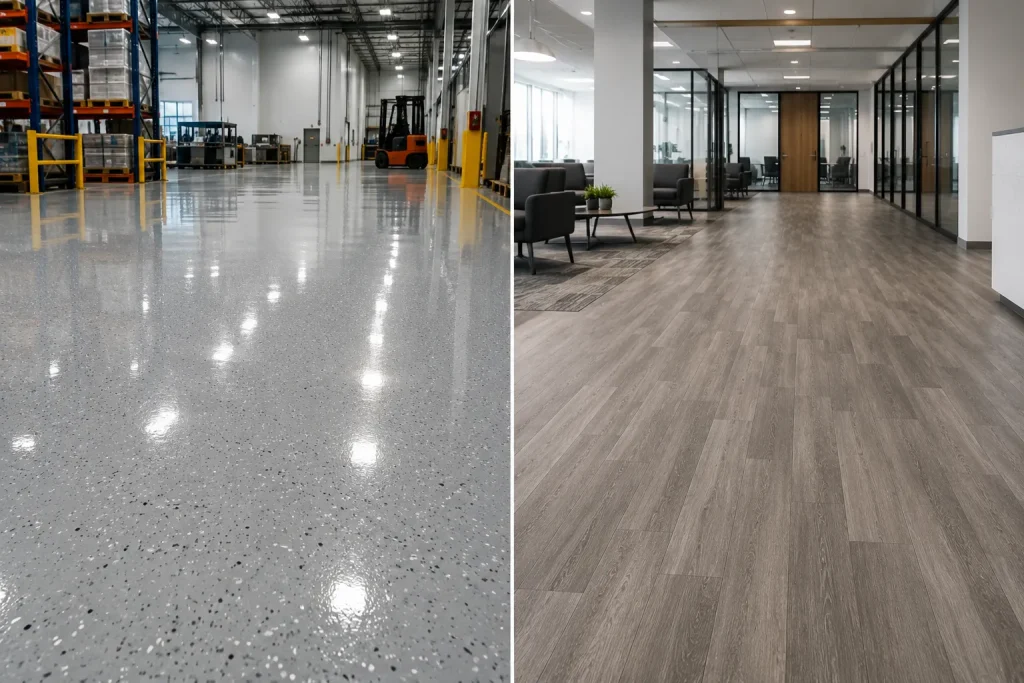
Choosing between Epoxy vs Vinyl Flooring is a common challenge for homeowners, businesses, and facility managers. Both flooring systems offer durability, attractive finishes, and long service lives. However, long-term value depends on installation costs, maintenance requirements, lifespan, and performance under daily use. Understanding these factors helps avoid expensive replacement costs later.
Recent flooring industry data shows that commercial flooring replacement costs increased by 18% between 2021 and 2025. As a result, buyers are focusing more on lifecycle costs rather than upfront pricing. Epoxy flooring remains popular in warehouses, manufacturing facilities, and garages. Vinyl flooring dominates residential spaces, retail stores, offices, and healthcare facilities.
From our experience evaluating flooring projects across industrial and commercial environments, long-term value often depends on traffic levels and environmental conditions. A warehouse operating 24 hours a day has very different flooring requirements than a residential kitchen. This comparison examines costs, durability, maintenance, aesthetics, and return on investment to determine which flooring option provides stronger long-term value.
Epoxy vs Vinyl Flooring starts with understanding their construction. Epoxy flooring is a resin-based coating applied directly onto concrete surfaces. The system consists of resin and hardener components that chemically bond to create a seamless surface.
Vinyl flooring is manufactured from polyvinyl chloride (PVC) layers. Modern luxury vinyl plank (LVP) and luxury vinyl tile (LVT) products feature wear layers, printed designs, and waterproof cores. These products replicate hardwood, stone, and ceramic appearances with impressive realism.
The installation process differs significantly. Epoxy requires surface preparation, crack repair, priming, and curing. Most systems require 24 to 72 hours before full use. Vinyl installations are faster, often completed within one day.
Key differences include:
Epoxy creates a seamless surface.
Vinyl comes in planks, sheets, or tiles.
Epoxy bonds permanently to concrete.
Vinyl can be replaced section by section.
Epoxy excels in industrial settings.
Vinyl offers greater design flexibility.
These distinctions directly affect long-term ownership costs.
When evaluating Epoxy vs Vinyl Flooring, upfront cost tells only part of the story. Material and installation costs vary widely depending on product quality and project complexity.
| Flooring Type | Installed Cost per sq. ft. | Typical Lifespan |
|---|---|---|
| Standard Epoxy | $4–$8 | 10–15 years |
| Industrial Epoxy | $8–$15 | 15–20 years |
| Sheet Vinyl | $2–$5 | 10–15 years |
| Luxury Vinyl Plank | $4–$12 | 15–25 years |
Epoxy generally requires higher preparation costs. Concrete grinding alone can add $1 to $3 per square foot. However, properly installed industrial epoxy often survives heavy traffic for more than 15 years.
Luxury vinyl flooring delivers excellent value in residential and light commercial spaces. Premium products with 20-mil wear layers commonly achieve service lives exceeding 20 years. Damaged sections can also be replaced individually, reducing repair costs.
Industry flooring consultants frequently recommend calculating annual ownership cost rather than installation cost alone. A $10 floor lasting 20 years often costs less annually than a $5 floor requiring replacement after 8 years.
Durability remains one of the most important factors in Epoxy vs Vinyl Flooring comparisons. Performance varies depending on traffic, moisture exposure, chemical contact, and impact resistance.
Epoxy flooring excels under heavy equipment, forklifts, and industrial machinery. High-performance systems withstand thousands of pounds of rolling loads daily. Chemical-resistant formulations also protect against oils, solvents, and industrial cleaners.
Vinyl flooring performs exceptionally well in residential and retail environments. Waterproof cores resist spills, humidity, and moisture damage. Modern wear layers protect against scratches, stains, and everyday foot traffic.
Performance comparison:
Epoxy resists chemicals better.
Vinyl offers superior comfort underfoot.
Epoxy handles heavy machinery loads.
Vinyl reduces noise transmission.
Epoxy withstands abrasion effectively.
Vinyl tolerates household moisture well.
Facility managers often prefer epoxy for warehouses and manufacturing plants. Interior designers frequently select vinyl for homes, offices, and hospitality spaces due to its visual versatility. Explore our solutions for Epoxy vs Vinyl Flooring.
Maintenance costs significantly influence the overall value of Epoxy vs Vinyl Flooring. Both materials require less maintenance than carpet or hardwood, but their needs differ.
Epoxy flooring requires routine sweeping and occasional mopping. Industrial facilities often use automated floor scrubbers to maintain appearance. Depending on traffic levels, recoating may be necessary every 7 to 10 years.
Vinyl flooring requires regular sweeping and damp mopping. Most manufacturers recommend pH-neutral cleaners. Unlike epoxy, damaged planks or tiles can often be replaced individually without refinishing the entire floor.
Aesthetically, vinyl offers unmatched flexibility. Manufacturers now produce designs that closely mimic oak, maple, marble, slate, and concrete. Epoxy delivers a modern appearance with metallic finishes, decorative flakes, and high-gloss surfaces.
Our flooring specialists consistently observe that businesses prioritize epoxy for functionality, while homeowners often choose vinyl for appearance and comfort. The best long-term return comes from matching flooring performance to the environment rather than selecting solely on price.
The answer to Epoxy vs Vinyl Flooring depends on where the floor will be used. Epoxy delivers stronger long-term value in industrial, warehouse, and heavy-duty commercial environments. Its chemical resistance, durability, and seamless finish justify higher installation costs. Vinyl flooring offers excellent value for homes, offices, healthcare facilities, and retail spaces. It combines attractive designs, easier repairs, and lower maintenance requirements. When evaluating lifecycle costs, durability needs, and aesthetic goals together, buyers can select a flooring system that delivers reliable performance and lasting value for years to come.
